MOREE old boy Max Hitchins has done it again.
The man known widely as the Hospitality Doctor and Melbourne Cup expert has written another book – and his latest work of historical non-fiction is a ground-breaking, world-first.
Chasing Gold is a collection of short stories about the incredible athletes who have experienced the highs and lows of competing on the world sporting stage.
The release of Chasing Gold, dedicated to all summer and winter Olympians and Paralympians from around the word, was launched just in time for the Games of the XXXIII Olympiad in Paris.
What makes Chasing Gold a book of Olympic proportions are the QR-codes woven into the pages.
“The idea just jumped out,” Mr Hitchins said.
Chasing Gold is the first book written about the Olympic Games, packed with QR-codes so the reader can “meet the athlete”.
“After finishing a story, the reader can scan the QR-code and be taken to a YouTube clip about that Olympian,” Mr Hitchins explained.
“It might be an interview that was done, or a newsreel. In fact, there are some wonderful old newsreels from more than 50 years ago that are amazing.
“This type of thing has never been done before, and I’m proud to say, it’s been done by a guy from Moree,” he smiled.
“QR-codes have been around since 1992, but it wasn’t until Covid that they really started to take off.
“Now, more than ever, everyone is using QR-codes for a million different reasons.”


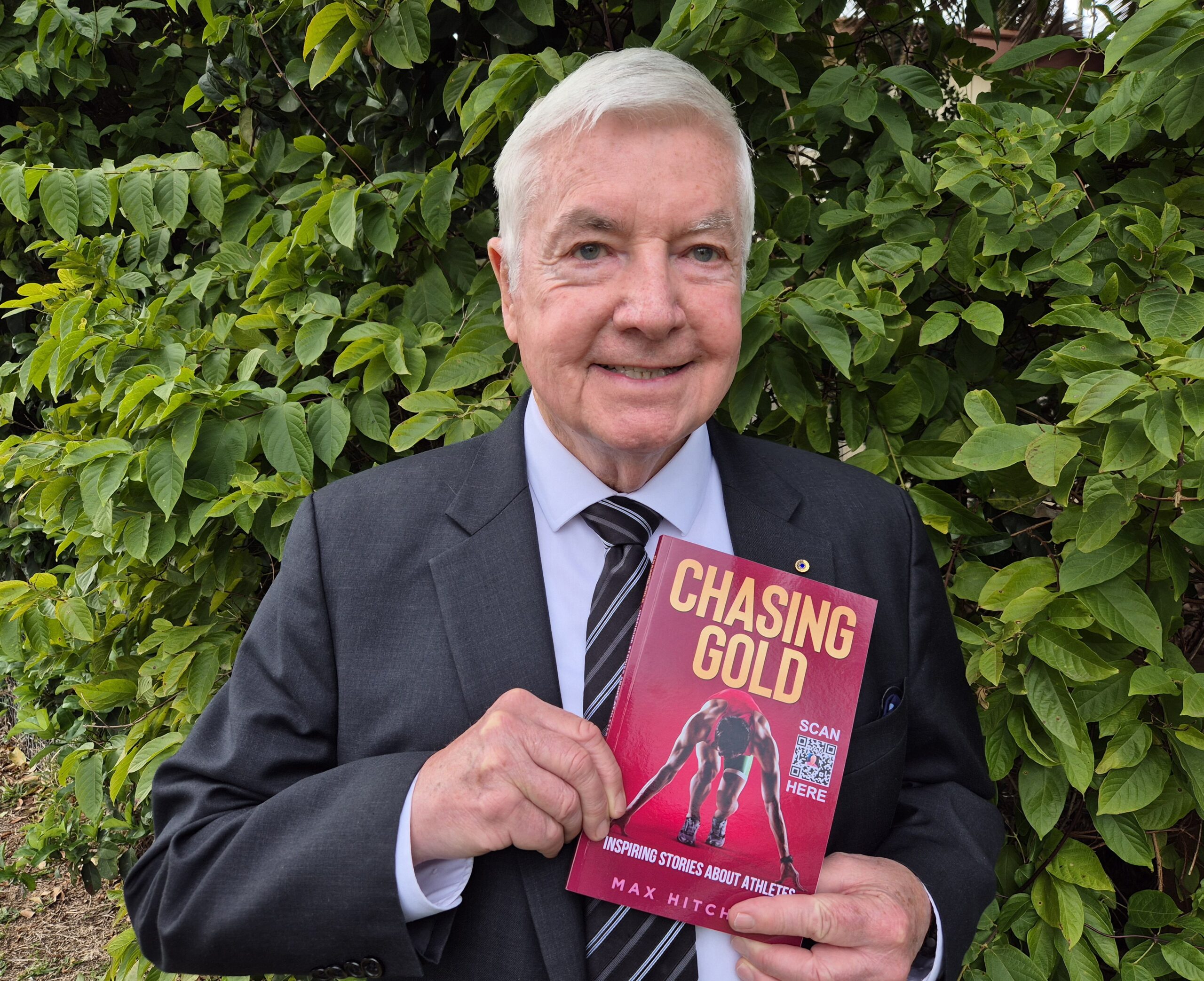
Max, a proud devotee of the Australian Olympic movement, has for many years been collecting and documenting stirring stories about Olympians from around the world.
Now’s he’s put those stories together into the revolutionary book, Chasing Gold.
“There are stories about Olympians from the first games in 1896, the first Winter Olympics in 1924 at Chamonix, the first Paralympic Games in 1960 in Rome, and the games right through to the present,” Max said.
At 81, Max’s bio is vast. He’s a poet, pilot, pianist, publican, memory magician, Melbourne Cup raconteur and author of several books including Fact, Fiction & Fables of The Melbourne Cup, How to Develop a Memory Like an Elephant and Post-Pandemic Thinking.
Chasing Gold is available at Amazon or visit Max’s website, www.chasinggold.com.au/p/chasing-gold.html
Max collated a series of interesting facts about the Olympic Games, which are published below.
Obstacle race
The 1900 Paris Olympics included a Men’s 200-metre swimming obstacle race. There were three obstacles. The competitors first had to climb over a pole, climb over a row of boats, and swim under another row of boats. It was won by Frederick Lane of Australia.
He ‘decked’ Joe Frazier
The first man to ‘deck’ American boxing legend Joe Frazier was Aussie Athol McQueen from Kyogle, NSW. He did it at the 1964 Olympics Games in Tokyo. Athol says he should have ‘sat on’ Joe once he had knocked him down. A maddened Joe got up and gave Athol a ‘hiding’.
Oldest Olympian
Swedish shooter Oscar Swahn competed at three Olympic games and won six medals, including three gold. Swahn holds records as the oldest Olympian at the time of competition, the oldest person to win gold, and the oldest person to win an Olympic medal. He competed at the 1908 Olympics (London); 1912 (Stockholm); 1920 (Antwerp). He was 72 when he competed in Antwerp.
Kobe Bryant
Only one Olympian has won an Olympic gold medal and an Oscar. In 2008, American basketballer Kobe Bryant took home his first gold medal from the Beijing Summer Olympics. He replicated the feat at the 2012 London Games. In 2018, he won an Oscar for an animated short film he wrote and narrated: Dear Basketball. It ultimately became a tribute to the life and legacy of the star who tragically lost his life in a helicopter accident in 2020.
Tarzan was an Olympian
In 1924, American swimmer Johnny Weissmuller won three gold medals and one bronze at the Olympic Games. He was regarded as one of the world’s best swimmers in the 1920s. He won 52 US National Championships and set 67 world records. After his swimming career, he portrayed ape man Tarzan in twelve films.
He stopped for ducks
In the Amsterdam Olympics of 1928, Australian sculler Bobby Pearce was leading in his quarter-final when the crowd on the canal bank alerted him to a duck and her ducklings crossing the course directly in his path. He stopped rowing . . . but still won the Gold Medal.
Whisky salesman wins
In 1930, after winning the Empire Games single sculls at Hamilton, Ontario, Bobby Pearce accepted an offer from Lord Dewar, the Scotch whisky tycoon, to become his Canadian sales representative. When Lord Dewar nominated Pearce for the Henley Regatta in England, as a lead-up to the 1932 Olympics, it was under the stated occupation of ‘whisky salesman’. Prior to this, Bobby Pearce was a carpenter. But tradesmen were not acceptable to the Henley Regatta committee. He went on to easily win the Diamond Sculls event and Gold Medals at the 1932 Olympics in Los Angeles.
How fast are long-distance runners
In her final Olympic preparation, UK athlete Keeley Hodgkinson ran in the London Diamond League. She clocked 1min 54.61sec – the fastest 800m anywhere in the world since Caster Semenya in 2018. In a London Gym, BBC Sport challenged regular gym goers to keep up with Keely Hodgkinson’s 800m pace on a treadmill.

Shane Gould: Retired at 16
After the 1972 Munich Olympics, Shane Gould famously retired at 16 years of age, due to the immense pressure and media scrutiny she faced. She is the only person, male or female, to hold every world freestyle record from 100m to 1500m and the 200m individual medley world record simultaneously, which she did from December 12, 1971 to September 1, 1972.
Dawn Fraser: Won Gold at three Olympics
In the 1966, 1960, and 1964 Olympics, Dawn Fraser won Gold medals in the 100m freestyle. Her triple gold medals across three Olympic Games makes her one of four swimmers to have ever won individual gold medals for the same event at three successive Olympics.
Louise Sauvage: Underwent 21 surgeries
Before Paralympian Louise Sauvage was 10 years of age, she had 21 surgeries. She won nine Gold and four Silver medals. As well as that, she had four victories in the Boston Marathon.
Fanny Durack: First Aussie female Gold medallist
This honour goes to Sarah Durack, known widely as Fanny. She won the 100m freestyle at Stockholm Olympics in 1912.
Aussie Olympian and film star
“Snowy” Baker (1884–1953) was an Australian Olympian, athlete and actor in the days of silent films. In 1904 he represented Australia in two rugby Test matches against Great Britain. At the 1908 London Olympics he represented Australasia in swimming and diving. As well, he took part in the middleweight boxing event in which he won a silver medal. Baker also excelled in horsemanship, water polo, running, rowing and cricket. In 1919 he starred in the Australian-made silent movie The Man from Kangaroo.
Norwegian Olympian became a film star
Sonja Henie was a Norwegian figure skater and film star born in 1912, in Kristiania (now Oslo), Norway. After the 1936 World Figure Skating Championships, with the help of her wealthy parents, Henie transitioned to a professional career in acting and live shows. She moved to America and became one of the highest-paid actresses in Hollywood. As well, she became the most famous Norwegian woman in the 20th century.
Biggest upset in running history?
The Men’s Marathon at the Paris Olympics is to be run on Saturday, August 10. The Women’s Marathon will be run the following day. Perhaps the biggest upset in Marathon history happened at the 1952 Helsinki Olympic Games. Prior to these Games, Emil Zátopek from Czechoslovakia, had
won 75 consecutive distance races, mostly 5000 and 10,000 metre events. After winning both of
these events in Helsinki, Zátopek decided he would like to run his ‘first’ Marathon.
Winning Gold in the 5000 metres and 10,000 metres was impressive enough, but his decision to join the Marathon on a whim displayed his audacity. Remarkably, he clinched Gold. That win, as well as Gold in the 5000 metres and 10,000 metres is a feat unmatched in Olympic Games history.
Zátopek’s unconventional training methods set him apart. His dedication and hard work when he became the first runner to break the 29-minute barrier in the 10,000 metres in 1954. His friendly personality, fluency in six languages, and camaraderie with fellow athletes made him a beloved figure in the global sports community.

Greatest Aussie Olympian
Benny Elias, the legendary State of Origin rugby league player, rates Peter Hadfield as one of the greatest sportsman Australia has ever produced.
Why?
Probably because Peter Hadfield was Australia’s decathlon champion for 10 consecutive years, beginning in 1976.
As well, Hadfield represented Australia at two Olympic Games and two Commonwealth Games, and was second to Daly Thompson in the decathlon in the 1978 Commonwealth Games.
1956 Olympic Flame ‘hoax’ in Australia
In 1956, amid Olympic fervour, Barry Larkin, a Melbourne veterinary student, staged a daring prank with a homemade torch.
Posing as an Olympic torchbearer, he astonished onlookers, including police and Sydney’s Lord Mayor Pat Hills.
Larkin smoothly continued the charade to Sydney Town Hall, intending to challenge the torch relay’s Nazi-linked origins.
The fake torch was made of a wooden chair leg painted silver, on top of which was a plum pudding can. A pair of underpants, worn by one of the students in National Service, was put inside the can, soaked in kerosene.
Tradesmen not permitted
Champion Australian skuller, Bobby Pearce, attempted to enter the Diamond Skulls at Henley as a lead-up to the 1928 Olympic Games in Amsterdam. However, he was deemed ineligible to compete, because he was a carpenter. Henley rules barred tradesmen from competing at Henley. Lord Dewar, the whisky magnate, came to his rescue, offering Pearce a job as a ‘Whisky Salesman’. This immediately made him acceptable! Pearce went on the win the Gold Medal in the single skulls event at the 1928 Olympics after stopping to allow a mother duck and her ducklings to cross in front of him during the race. He won the same event again in 1932 in Los Angeles.
Dietrich Choltitz
While the world has been in awe of the Eiffel Tower, featured prominently in the Paris Games’ opening ceremony, Max wonders if anyone has stopped to say “thanks” to Dietrich Choltitz.
Max writes, in 1944 Hitler ordered General Choltotz to destroy the Eiffel Tower. He disobeyed Hitler’s orders and instead surrendered Paris to the Free French Forces on August 25, 1944.
Choltitz later asserted his defiance of Hitler’s direct order stemmed from its obvious military futility, his affection for the French capital’s history and culture, and his belief Hitler had, by then, become insane
In case you missed Eric
A swimmer from Equatorial Guinea, Eric Moussambani, gained entry to the 2000 Sydney Olympics without meeting the minimum qualification requirements via a wildcard draw designed to encourage developing countries without expensive training facilities to participate. Eric had learned to swim only eight months before the Olympics. He trained in a 20-metre pool at a hotel in Malabo. He had never seen a 50m pool before the Olympics. When two other competitors were disqualified, Eric swam on his own in his heat and received a standing ovation from the crowd of 17,500. His time for the 100m was 1.52.72. (The current record for the 100m is 47.02).
Wacky Sports
Some people have commented negatively on the new additions of Breaking and Trampolining being added to the list of Sports for the Paris Olympics. Wacky? Not really. Consider some of the Sports of past years: Distance plunging; live pigeon shooting; running deer shooting; long jump for horses; standing high jump; underwater swimming in the seine; obstacle swim; and chorus singing.
Italian high-jumper loses wedding ring
Italian high-jumper Gianmarco Tamberi has issued a heartfelt apology to his wife after losing his wedding ring during the opening ceremony of the Paris Olympics. The 32-year-old world champion was enthusiastically waving the Italian flag from a boat on the River Seine with fellow athletes when the ring slipped off his finger. Tamberi attributed the mishap to his recent weight loss and overwhelming excitement. Reflecting on the incident, he said: “If it had to happen, if I had to
lose this ring, I couldn’t imagine a better place”, adding the ring will now “remain forever in the riverbed of the city of love”.
Olympian survived Titanic disaster
Richard (Dick) Norris Williams, 21, survived the Titanic’s sinking in 1912, avoiding leg amputation by walking around and around the rescue ship, Carpathia. He won multiple tennis titles, including a mixed doubles gold at the 1924 Paris Olympics, the US National Championships in 1914 and 1916, and Wimbledon doubles titles in 1920, 1925, and 1926. Williams also served in WWI, earning the Légion d’Honneur and Croix de Guerre from the French Government.
Aussie medal count history
Up until these Paris Olympics Australia’s most successful medal count was at the 2000 Sydney Olympics. Our tally there was 16 Gold, 25 Silver and 17 Bronze. A total of 58 medals. Our worst result was at the 1936 Olympics when Jack Metcalfe won our only medal when he placed 3rd in the
Men’s Triple Jump. Our poor performance in the 1976 Olympics (1 Silver and 4 Bronze) prompted action from the then-Prime Minister, Malcolm Frazer. He was responsible for setting up the Australian Institute of Sport which opened in Canberra in 1981.
Chasing Gold is available at Amazon or visit Max’s website, www.chasinggold.com.au/p/chasing-gold.html